Every business has a moment where branding meets the floor: the entrance. A custom logo mat puts your mark exactly where every client, tenant, and visitor looks down — and unlike a sign, it works 365 days a year in the one spot traffic guarantees. Ordered well, it outlasts the paint on your walls. Ordered badly, it curls, fades, and quietly embarrasses the brand by spring. Here is what separates the two.
Logo Method: The Decision That Matters Most
There are three ways logos get onto mats, and they are not interchangeable:
- Molded/inlaid rubber: The design is cut into the mat itself in contrasting rubber — there is no print layer to wear. This is the method behind the rubber anti-slip logo mat: the logo survives salt, shovels, and years of shoes because it IS the mat.
- Printed carpet surface: Full-color photographic reproduction on nylon pile. Choose this when the logo needs gradients and multiple colors; expect honest life of 2–4 years in high traffic.
- Surface print on rubber: Cheapest, and it shows — UV and abrasion take printed logos off rubber within a season or two. Fine for events, wrong for entrances.
Sizing and Placement: Where the Logo Gets Seen
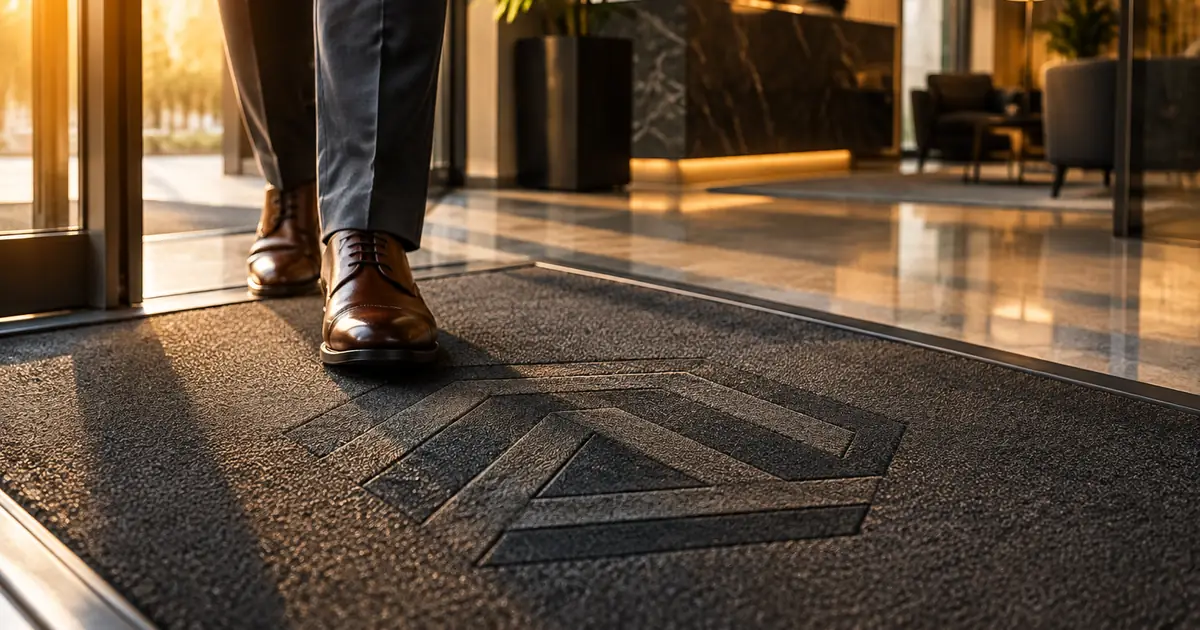
The logo mat belongs inside the entrance — position two, after the scraper mat — where visitors have taken two steps, slowed, and actually look down. Size it to the traffic path, not the wall: a 24x36 mat suits a single door, 36x48 suits doubles, and the polyester logo mat line covers the standard lobby sizes. Center it in the walking direction; a logo mat placed off the natural path is a logo mat nobody sees.
One Logo or Many? Multi-Location Consistency
Franchises and multi-location operators should standardize the mat spec before the first order: one size, one logo method, one placement rule — documented and sent to every location. The alternative is six branches with six interpretations of the brand, which is exactly what visitors compare when they visit more than one. Ordering all locations together also crosses the quantity break on custom production, and replacement orders stay consistent because the spec sheet, not anyone's memory, defines the product.
Color Strategy: Contrast Is Legibility
The rule brand designers use for embroidery applies here: your logo needs contrast against the mat, not the wall. Dark charcoal mats carry light logos beautifully; black mats need light gray, white, or metallic-tone logos to read at a glance. If your brand palette is dark-on-dark, consider a two-tone mat where the field lightens around the mark. And resist the urge to shrink the logo: a mat logo should fill 60–80% of the mat's width to read from the door.
The Practical Specs to Check Before Ordering
- Backing: Nitrile rubber for smooth floors (grips), vinyl for carpet (lays flat).
- Pile/texture: Low pile for door clearances under half an inch; plush only where doors swing wide.
- Edges: Beveled, always — square edges curl and become the trip hazard your insurer asks about.
- Care: Confirm the mat vacuums clean without snagging the logo layer.
Proofing: The Step That Prevents Remakes
Reputable producers email a digital proof before production — a rendering of your logo on the mat with exact dimensions. Approving that proof is a contract: it confirms the design, orientation, and size, and custom orders produced to an approved proof are generally non-returnable. So treat the proof like a check you are signing: view it at arm's length (the distance your visitors will see it), confirm the logo reads at that distance, and check the orientation against your traffic flow twice. Thirty seconds of proofing saves the six-week remake.
Beyond the Entrance: Where Logo Mats Work
The same logic scales across a facility. Branded mouse pads put the logo in daily client contact (and ship beautifully in gift boxes). Custom bar mats brand the highest-dwell spot in any venue — the rail where guests rest their elbows and their attention. Counter mats brand the checkout moment. One brand, consistent mark, repeated at every natural point of eye contact with the floor.
What a Good Logo Mat Costs — and Returns
Quality molded-logo rubber mats run $40–135 depending on size; printed carpet versions run similar. Against that: years of floor protection (the mat's actual job), a professional first impression at every entry, and the end of the "who let the lobby look like this" conversation. For most businesses the mat pays for itself in floor maintenance alone within the first year — the branding is effectively free after that. Browse the logo mat collection, or email us your logo file and doorway dimensions — we will tell you honestly which method and size fits.